Every person wants to have a bright smile. A bright and confident smile can be one of your most powerful and valuable assets, in both social and professional situations. Having a bright smile also shows good oral health.
Several things can destroy your smile, and one of the most prominent is having missing teeth. Teeth are important to us, not just for smiling but they help us chew food, speak properly, and they uphold the integrity of our facial features.
Due to the important role performed by teeth in our body, people with missing teeth are looking for tooth replacement options that will suit them. Thankfully, with today’s advancement in technology, patients with missing teeth can choose from several tooth replacement options. In this article, we will review dental implants versus dentures, as tooth replacement options so that you can choose what’s best for you.
Dentures
Also known as false teeth, dentures are prosthetic devices created to replace missing teeth. They are usually custom-made so that they can match the patient’s mouth structure and form. Made of acrylic, a plastic base, and porcelain teeth element, dentures fill the gaps left by missing teeth as well as helping facial and jaw muscles function.
There are partial dentures that only cover part of the mouth and are usually held in position with clasps that hold onto the remaining natural teeth. While dentures might take a while getting used to, they feel more natural.
Dentures require routine care and cleaning to ensure that they remain moist and clean. Due to changes in facial and bone structure, dentures need to be replaced every 7-15 years. This is also because of wear and tear. Also, they require routine adjustments by a dentist and often need to be held in place using adhesives. Another problem with this tooth replacement option is that some patients experience a clicking noise when chewing food, which can be very embarrassing.
Dental Implants
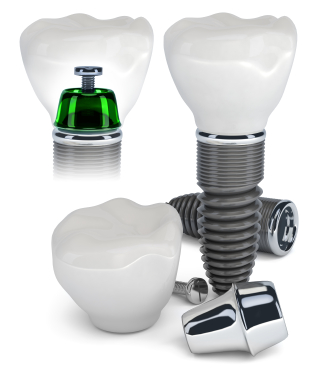
These are permanent solutions for missing teeth. Usually, a dental implant is not removable and is made of titanium which is fully compatible with the human body. The procedure is painless and involves implanting a small titanium rod in your jawbone to replace the root part of the missing tooth. This implant will act as a natural root and therefore help preserve the jawbone from bone loss and deterioration that would happen otherwise.
Once the implant is placed into the jaw, the dentist will connect the replacement tooth permanently to the dental implant. The result is a natural-looking tooth that looks and functions like a real tooth.
Just like natural teeth, care and cleaning of dental implants are imperative. You should brush and floss them daily to keep them in the best shape possible. Although dental implants are more expensive than dentures, they are long-lasting, more comfortable and aesthetically pleasing.